Showing posts with label XB2001. Show all posts
20130417
Level Development
Initial Development
I had original thought to produce a very organic flowing map based on an environment made of sweets and chocolate, this changed soon after this quick concept. It then changed to become a level based upon flowing down a canyon in a raft, but having realised I couldn't apply any puzzles or a great deal of kismet to it I decided to resort to a more traditional FPS style level. I have looked in to developing the landscape around desert terrain and canyon like cliff faces, so I am looking to enclose the level through a combination of these two extremes.
After iterating level concepts in UDK I came up with a level that doesn't look much like the concept above, it had to drastically change from the initial concept to work as a first person exploration game. After coming up with a basic level in UDK that I had reviewed half way through the module, I was told to make it more 'exciting' and give more challenge to the player and to incorporate more Kismet based events.
Here are a number of screenshots from the initial UDK level, unfortunately I didn't take a great deal of top down photos of the completed map and my packages have all become broken trying to rename/restructure the packages for professionalism.
I produced a new blockmap in my sketchbook to work from, creating a new level from scratch but now with the existing knowledge of my previous endeavour.
Sketches of gameplay ideas
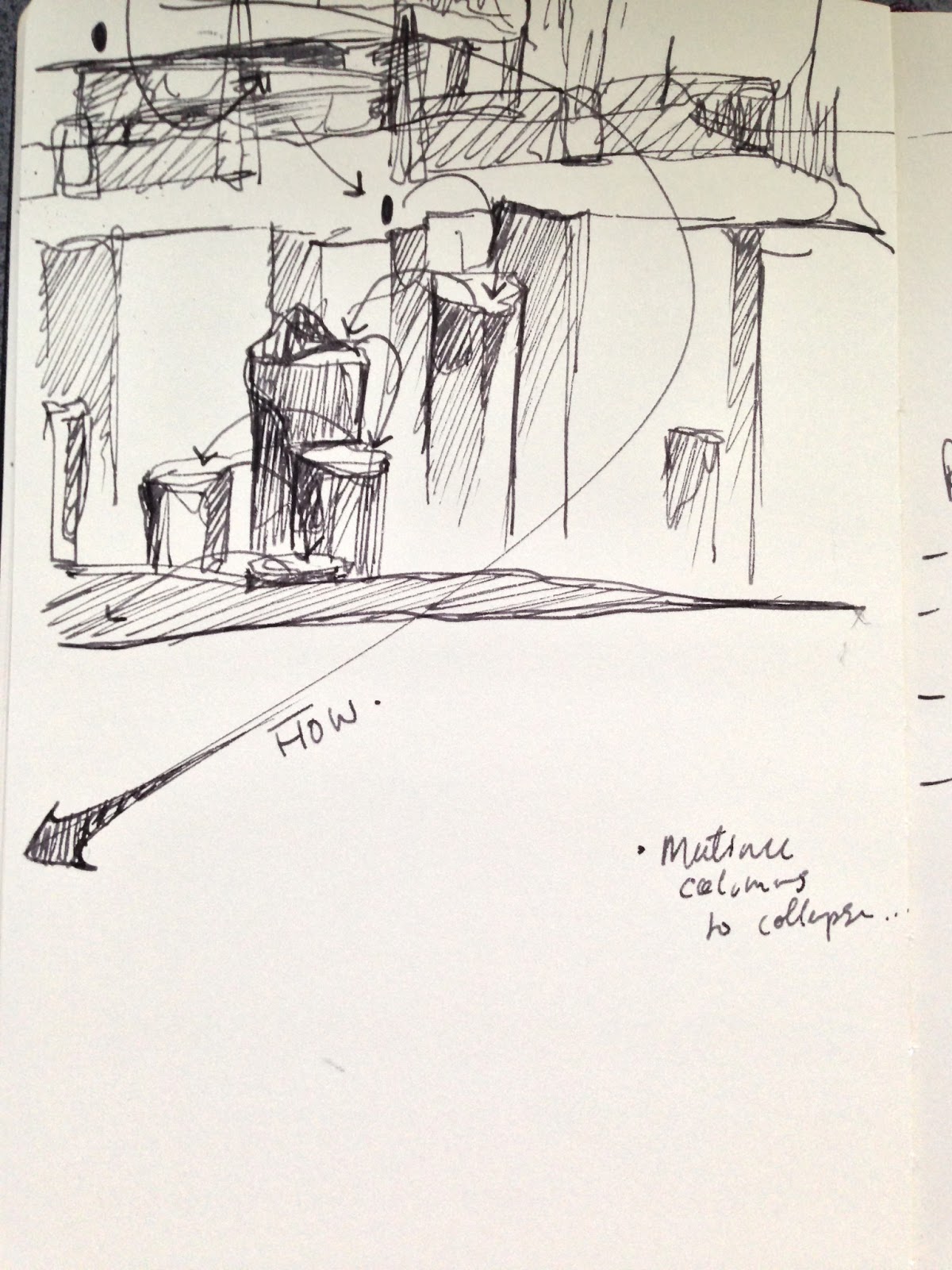
This sketch shows the idea of the player platform hopping across a steep drop from a cliff edge, the stacks get smaller to the other side to 'ease' the player in to the concept of platforming in first person.
This sketch looks in to a later part of the level which unfortunately I didn't have time to complete, It was where I would tie-in the architecture module assets from XB2002 with the organic landscape that floods the level.
Again, this sketch also relates to a later puzzle which I didn't have time to create. It was an expansion on the simple puzzle I have incorporated already in to the level, but it involves translating the symbol seen on the wall with the 3D cylinder which rotates within the wall.
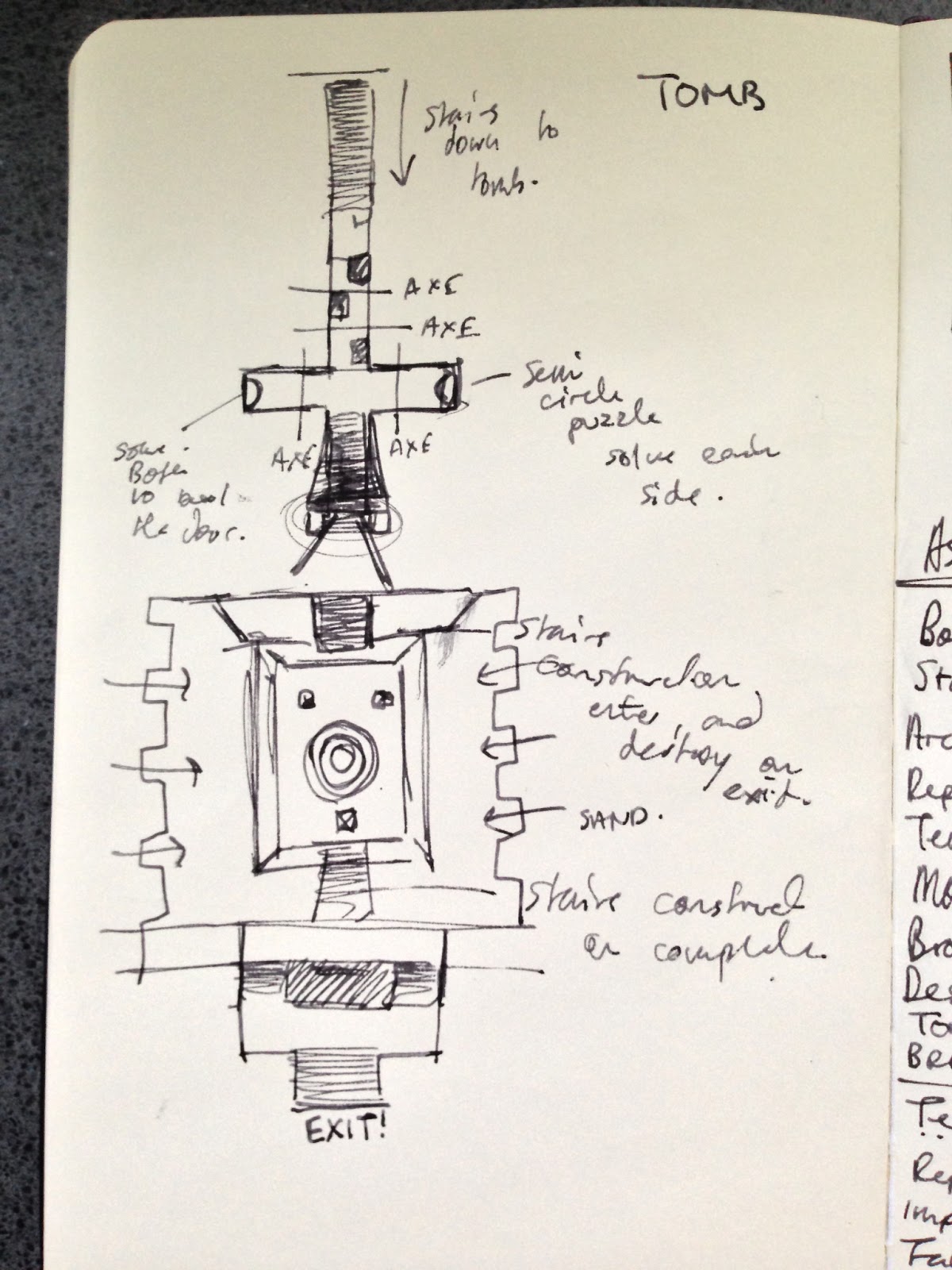
This section looks at the player entering the tomb section of the level, here the player would put all of what they have learned up to this point to the test. The tomb is a time based event, when triggered the player has X amount of time to complete the series of challenges. They include navigating the narrow corridor, solving two slightly more complex wall/cylinder puzzles (to stop the axes and open the main tomb door) and on entering completing a four-tiered cylindrical puzzle using the adjacent obelisks as clues before the tomb fills with sand (from the exterior wall holes).
And this is what I created which is just out of reach at the current-end of the level, suggesting what was to come but not giving too much away (other than in this blog post...)
Puzzle Concept, how visually it would be placed and thought process before applying idea in Kismet.
20130314
Level Environment Concept
I'm looking to create an immersive experience within UDK based on an arizona desert type theme, crossed with the mystical architecture and hieroglyphics of the ancient Egyptians. I plan to produce a range of different assets for this project, some of which will be unique and independent where as others will be constructed with modular development in mind.
I have produced a series of mood boards to help assist me get a realistic setting to my environment, and that everything that is within it 'could' be found there. The colours within these photographs will help me bind the land, foliage and sky together. It helps clearly show the relationship between the clouds, and how they reflect off the colour of the planes below. I also like how colours you don't expect before actually researching help bring a sense of depth to the rocks.
20121125
Modular Asset Integration
For an on-going project I produced a series of customisable modular assets that a level designer could easily use to block out new maps. The current system we were using led to unreliable wall heights, widths, irregular doors and was causing each level to be significantly different in terms of design and gameplay.
Here is an example of the simple meshes aligned together to produce a corridor, you can see how the level designer can easily make windows, doors or double doors visible at the click of a button. This makes the design process so much faster for getting the main gameplay down for a level, once this is done the data can then be exported to a 3D modelling package so assets can be designed to fit perfectly within the space designed previously by the level designer.
This shows the progression of a level ten minutes after the initial corridor, using the grid align function in Unity allows quick snapping of the pieces and converting the meshes to prefabs speeded up the process.
Beginning to get more creative with the level design I decided to use some of the door frames as windows on the second tier, and giving multiple rooms different heights.
Be Finally I applied some basic texture to the walls to help define the area for testing, I also integrated some of the mechanics such as the warrant doors (which now make a lot more sense giving two access points).
20121019
20121018
Assassins Creed II Telemetry
Geographic Game Testing
This method has been introduced by Ubisoft amongst most of its latest AAA Titles. It was inspired by a combination of software such as Google Maps and Microsoft Pivot Viewer, but adapted to the reality of game telemetry. The tool allowed the designers to pin-point exactly in 3D space how players navigated the map, tailored to the specific research requirements (time, distance, pathways). The colour of the lines shows the speed at which the player is moving, showing where the player is contemplating their next move, or scaling a wall.
An example of the software used by game analysts and designers for Assassins Creed II is shown below. It had been noted some players were mot taking the appropriate path to complete the mission which involved parashuting from a ledge to reach the end point. This was made visible by the analysis tool which brought the alternate view to the designers attention; it showed how they made an unintended alternate path which bypassed the tutorial and was 'less fun'. It is critical that the players do not get lost at such an early stage in a games narrative, to ensure they are kept in the flow of the game (giving them the best possible gameplay experience).
This method has been introduced by Ubisoft amongst most of its latest AAA Titles. It was inspired by a combination of software such as Google Maps and Microsoft Pivot Viewer, but adapted to the reality of game telemetry. The tool allowed the designers to pin-point exactly in 3D space how players navigated the map, tailored to the specific research requirements (time, distance, pathways). The colour of the lines shows the speed at which the player is moving, showing where the player is contemplating their next move, or scaling a wall.
An example of the software used by game analysts and designers for Assassins Creed II is shown below. It had been noted some players were mot taking the appropriate path to complete the mission which involved parashuting from a ledge to reach the end point. This was made visible by the analysis tool which brought the alternate view to the designers attention; it showed how they made an unintended alternate path which bypassed the tutorial and was 'less fun'. It is critical that the players do not get lost at such an early stage in a games narrative, to ensure they are kept in the flow of the game (giving them the best possible gameplay experience).
Assassins Creed : Multiplayer Maps
Abilities within Multiplayer
This is a list of the 15 abilities that are available to use in Assassins Creed revelations. These will be useful in understanding how to structure to my level to make these abilities effective or less effective.
• Tripwire Bomb
• Closure
• Teleport
• Bodyguard
• Throwing Knives
• Poison
• Smoke Bombs
• Morph
• Mute
• Charge
• Disguise
• Fire Crackers
• Templar Vision
• Hidden Gun
• Decoy
Level Design Analysis
I have looked in to the selection of multiplayer maps currently available on Assassins Creed Revelations, and its become apparent the variety of gameplay that is used within each of the maps. Each map is tailored to incorporate a slightly different play style, for example one map may be very open causing players to use skills sets based upon disguise and blending with civilians. Another map might use height as the main gameplay mechanic, causing players to play across different elevations.
Knights Hospital
The long corridors below the archways that surround the central square area offer plenty of opportunities to escape a pursuer. Not only can you easily break their line of sight using the pillars and gateways, but you also have access to several closing doors.
The central square offers concentric routes for moving easily between inner and outer paths or from the ground to the roof. Lifts on multiple sides of the square allows for almost immediate access to the rooftop, in the squares design it also allows players to evade pursuers quite effectively in its three dimensional setup.
Antioch
The sprawling, open nature of Antioch makes if very difficult to hide in the open without employing Abilities such as Morph or Disguise. It also makes it tricky to escape a Chase due to the line of sight being so hard to disrupt. The width of the streets makes it difficult to navigate the map efficiently from the rooftops, which in my opinion is great as so many players just run aimlessly around rooftops getting poor kills (It seems to be something only new players really do..).
This map also features a large number of hiding spots and chase breakers (to counter the openness). They are conveniently placed one after another, allowing a player to trigger the gate and then jump in to a hay bale out of sight of the pursuer. This will give you the opportunity to stun the player if they are foolish enough to follow you through the same route, of course it could backfire if the player is a little more experienced...
Galata
This level is situated on a hill, you will often find that your opponent is at a different elevation. Players are quick to scale the rooftops in this map giving away their position and identity to other players, more experienced players will wait for their prey to make a mistake from the rooftops.
The tight, narrow streets cause many players to seek there targets from the rooftops. Players will find the ground provides excellent cover when being pursued, using the streets this time to their advantage and combine this with the vast array of chase breakers placed around the map. This is a nice mechanic as you almost force the players to switch their elevation within the level frequently.
Souk
Souk is an interesting map in that it has no rooftops for players to roam on, meaning the action largely takes place amongst the ground and crowds. This makes the line of sight and compass less effective due to the sheer number of civilians on the same elevation as yourself.
The indoor section of Souk adds a new dynamic to the chase breaker; players can use a closing gate to block a player, but due to the design of the map they must then take a detour (as opposed to climbing directly over the same path). This gives the player more time to blend in with civilians or seek out their target before its to late.
[Map image unavailable]
Ippokratous
This map really works off the concept of tight turns, narrow streets and crossroads to bring players to confrontation. Due to the almost level-skyline of the buildings it allows players on rooftops to directly use hidden guns or throwing knives against their opponent, its better to stay on the ground on this map...
The interesting use of balconies and terraces can work to a player advantage, due to the ground based mind set players have they forget to check above them. Players situated on a balcony can watch below to see real players pushing through civilians, or notice strange behavior of a character directly beneath them (which is their pursuer).
[Map image unavailable]
Rome
Rome offers a combination of both open tight gameplay. The majority of gameplay revolves around the market which is situated just off centre in the map. The busy market offers plenty of blending spots and moving crowds for social stealth, it can play against a player if they break their cover though (The crowds move in bursts on this in particular, and seeing a single player break from a group is seen as an obvious giveaway...).
Players that are trying to escape a pursuer generally leave the market area to go to the tighter, narrow streets that surround the market.
The rooftops on this level offer fast access to any part of the map due to the nature of the street layouts, but you then run the risk of being easily spotted.
Mont St-Michel
This map is similar to the Rome map in that is has two very contrasting areas. The layout is more similar to a linear gradient than it is based on a central design. The top plaza in front of the churches main gate brings a lot of high profile action, which almost always leads to immediate detection. It makes incoming pursuers very easy to spot due to the open area, allowing for an escape to take place which heads towards the lower regions of the map. The lower region of this map is very tight and narrow, but not necessarily tall. This is countered by the use of underground tunnels.
[Map image unavailable]
This is a list of the 15 abilities that are available to use in Assassins Creed revelations. These will be useful in understanding how to structure to my level to make these abilities effective or less effective.
• Tripwire Bomb
• Closure
• Teleport
• Bodyguard
• Throwing Knives
• Poison
• Smoke Bombs
• Morph
• Mute
• Charge
• Disguise
• Fire Crackers
• Templar Vision
• Hidden Gun
• Decoy
Level Design Analysis
I have looked in to the selection of multiplayer maps currently available on Assassins Creed Revelations, and its become apparent the variety of gameplay that is used within each of the maps. Each map is tailored to incorporate a slightly different play style, for example one map may be very open causing players to use skills sets based upon disguise and blending with civilians. Another map might use height as the main gameplay mechanic, causing players to play across different elevations.
Knights Hospital
The long corridors below the archways that surround the central square area offer plenty of opportunities to escape a pursuer. Not only can you easily break their line of sight using the pillars and gateways, but you also have access to several closing doors.
The central square offers concentric routes for moving easily between inner and outer paths or from the ground to the roof. Lifts on multiple sides of the square allows for almost immediate access to the rooftop, in the squares design it also allows players to evade pursuers quite effectively in its three dimensional setup.
Antioch
The sprawling, open nature of Antioch makes if very difficult to hide in the open without employing Abilities such as Morph or Disguise. It also makes it tricky to escape a Chase due to the line of sight being so hard to disrupt. The width of the streets makes it difficult to navigate the map efficiently from the rooftops, which in my opinion is great as so many players just run aimlessly around rooftops getting poor kills (It seems to be something only new players really do..).
This map also features a large number of hiding spots and chase breakers (to counter the openness). They are conveniently placed one after another, allowing a player to trigger the gate and then jump in to a hay bale out of sight of the pursuer. This will give you the opportunity to stun the player if they are foolish enough to follow you through the same route, of course it could backfire if the player is a little more experienced...
Galata
This level is situated on a hill, you will often find that your opponent is at a different elevation. Players are quick to scale the rooftops in this map giving away their position and identity to other players, more experienced players will wait for their prey to make a mistake from the rooftops.
The tight, narrow streets cause many players to seek there targets from the rooftops. Players will find the ground provides excellent cover when being pursued, using the streets this time to their advantage and combine this with the vast array of chase breakers placed around the map. This is a nice mechanic as you almost force the players to switch their elevation within the level frequently.
Souk
Souk is an interesting map in that it has no rooftops for players to roam on, meaning the action largely takes place amongst the ground and crowds. This makes the line of sight and compass less effective due to the sheer number of civilians on the same elevation as yourself.
The indoor section of Souk adds a new dynamic to the chase breaker; players can use a closing gate to block a player, but due to the design of the map they must then take a detour (as opposed to climbing directly over the same path). This gives the player more time to blend in with civilians or seek out their target before its to late.
[Map image unavailable]
Ippokratous
This map really works off the concept of tight turns, narrow streets and crossroads to bring players to confrontation. Due to the almost level-skyline of the buildings it allows players on rooftops to directly use hidden guns or throwing knives against their opponent, its better to stay on the ground on this map...
The interesting use of balconies and terraces can work to a player advantage, due to the ground based mind set players have they forget to check above them. Players situated on a balcony can watch below to see real players pushing through civilians, or notice strange behavior of a character directly beneath them (which is their pursuer).
[Map image unavailable]
Rome
Rome offers a combination of both open tight gameplay. The majority of gameplay revolves around the market which is situated just off centre in the map. The busy market offers plenty of blending spots and moving crowds for social stealth, it can play against a player if they break their cover though (The crowds move in bursts on this in particular, and seeing a single player break from a group is seen as an obvious giveaway...).
Players that are trying to escape a pursuer generally leave the market area to go to the tighter, narrow streets that surround the market.
The rooftops on this level offer fast access to any part of the map due to the nature of the street layouts, but you then run the risk of being easily spotted.
Mont St-Michel
This map is similar to the Rome map in that is has two very contrasting areas. The layout is more similar to a linear gradient than it is based on a central design. The top plaza in front of the churches main gate brings a lot of high profile action, which almost always leads to immediate detection. It makes incoming pursuers very easy to spot due to the open area, allowing for an escape to take place which heads towards the lower regions of the map. The lower region of this map is very tight and narrow, but not necessarily tall. This is countered by the use of underground tunnels.
[Map image unavailable]
Assassins Creed : Revelations Level Design
I have decided to choose the game mechanics from Assassins Creed Revelations to base my level design document on. I believe that Assassins Creed now has one of the most innovative and exciting multiplayer experiences currently available; a scoring system based off points and not kills, its about how you perform your assassinations - not your final body count. It has been carefully crafted to reward players for playing the game as the creators intended (not some mindless fps).
The multiplayer element is a very different experience to the single player adventure spent inside the Animus. The focus here is on free running, social stealth and constantly on the look out for your next assassination. An array of unlockable skills and abilities prevent gameplay turning in to generic open brawls, allowing a rich mixture of both hunting and evading other players.
I will be focussing on the 'Wanted' game type for my level design.
Wanted
Objective
The objective of this game type is to achieve the highest score within the given time limit.
Important elements within a multiplayer level
Hiding Spots
Hay-filled cars and straw piles are the most obvious and used hiding spots featured in the multiplayer game, jumping in to one of these completely removes you from view when inside. Kills made from within one of these spots brings generous bonuses as the player remains static, waiting for his target to pass directly in-front of their position. It also has its drawbacks, players staying in the same location are easy prey to a trained assassin. It is important to note that AI (civilians) never use this element so if another player witnesses you enter they know you are an assassin within the level.
Social Stealth
These are the most common form of hiding, blending in with a crowd of civilians (static or walking) or sitting next to other AI on benches will automatically bring your player to act like the other civilians within the crowd. It is very easy to make 'low profile' transition between groups, and to move slightly to become in reach of your passing target will still give you a bounty full kill score. You remain discreet/incognito whilst blending with civilians.
Chase Breakers
Chase breakers allow you to evade opponants in pursuit. There are three types which are easily identifiable within the game world as they glimmer a white of their Animus matrix outline. These chase breakers are activated when a 'high profile' activity such as sprinting occurs within its trigger area, allowing players/civilians to pass through them stealthily. Chase breakers reset after a short period of time, they do not act as permanent safe areas for players, but give them just enough time to disrupt the flow of the opponent.
Lifts
Collide with this component via running or free running to activate. The counterweight propels your player instantly to the top of the roof level. This can also be used from dropping down from the roof, on to the component and then activate it to send you instantly back up. This works well in situations where your pursuer is directly behind you.
Closing Gates
These are activated by running at speed through the gate entrance. On entering the gate slams shut preventing any other player from entering for a few seconds, causing the chaser to take an alternative route. This should be used with caution as it can work against a player, trapping them in almost a tunnel (which their pursuer could be at the other end of).
Corner Helpers
This component works in two ways to assist you in breaking a chase. Swinging and jumping across beams high up on the buildings can lead to beautifully flowing free running, but using a corner helper will prevent a pursuer from using the exact route you have as it can only be used every few seconds. Its second benefit is because it is used on the corner of a building, it automatically takes you out of the line of site of a following opponent.
The multiplayer element is a very different experience to the single player adventure spent inside the Animus. The focus here is on free running, social stealth and constantly on the look out for your next assassination. An array of unlockable skills and abilities prevent gameplay turning in to generic open brawls, allowing a rich mixture of both hunting and evading other players.
I will be focussing on the 'Wanted' game type for my level design.
Wanted
Objective
The objective of this game type is to achieve the highest score within the given time limit.
- 4 - 8 Players
- 1 round of 10 minutes
- You are both predator and prey, but are only allowed to kill you assigned target.
- Compass is enabled for this game type, enabling you to anticipate a targets route and change yours accordingly to cut them off.
- It is a harder game type than Deathmatch in that your pursuer has a compass, however there are duplicates of your persona around the map making it easier to blend or lose a pursuer.
- It is sometimes more efficient to take time to identify and escape a pursuer before tracking your own target, this is because staying alive can lead to 'streaks' and allow you to gain additional points per kill.
Important elements within a multiplayer level
Hiding Spots
Hay-filled cars and straw piles are the most obvious and used hiding spots featured in the multiplayer game, jumping in to one of these completely removes you from view when inside. Kills made from within one of these spots brings generous bonuses as the player remains static, waiting for his target to pass directly in-front of their position. It also has its drawbacks, players staying in the same location are easy prey to a trained assassin. It is important to note that AI (civilians) never use this element so if another player witnesses you enter they know you are an assassin within the level.
Social Stealth
These are the most common form of hiding, blending in with a crowd of civilians (static or walking) or sitting next to other AI on benches will automatically bring your player to act like the other civilians within the crowd. It is very easy to make 'low profile' transition between groups, and to move slightly to become in reach of your passing target will still give you a bounty full kill score. You remain discreet/incognito whilst blending with civilians.
Chase Breakers
Chase breakers allow you to evade opponants in pursuit. There are three types which are easily identifiable within the game world as they glimmer a white of their Animus matrix outline. These chase breakers are activated when a 'high profile' activity such as sprinting occurs within its trigger area, allowing players/civilians to pass through them stealthily. Chase breakers reset after a short period of time, they do not act as permanent safe areas for players, but give them just enough time to disrupt the flow of the opponent.
Lifts
Collide with this component via running or free running to activate. The counterweight propels your player instantly to the top of the roof level. This can also be used from dropping down from the roof, on to the component and then activate it to send you instantly back up. This works well in situations where your pursuer is directly behind you.
Closing Gates
These are activated by running at speed through the gate entrance. On entering the gate slams shut preventing any other player from entering for a few seconds, causing the chaser to take an alternative route. This should be used with caution as it can work against a player, trapping them in almost a tunnel (which their pursuer could be at the other end of).
Corner Helpers
This component works in two ways to assist you in breaking a chase. Swinging and jumping across beams high up on the buildings can lead to beautifully flowing free running, but using a corner helper will prevent a pursuer from using the exact route you have as it can only be used every few seconds. Its second benefit is because it is used on the corner of a building, it automatically takes you out of the line of site of a following opponent.
Subscribe to:
Posts (Atom)